
Introduction: The Most Valuable Currency Isn’t Money—It’s Attention
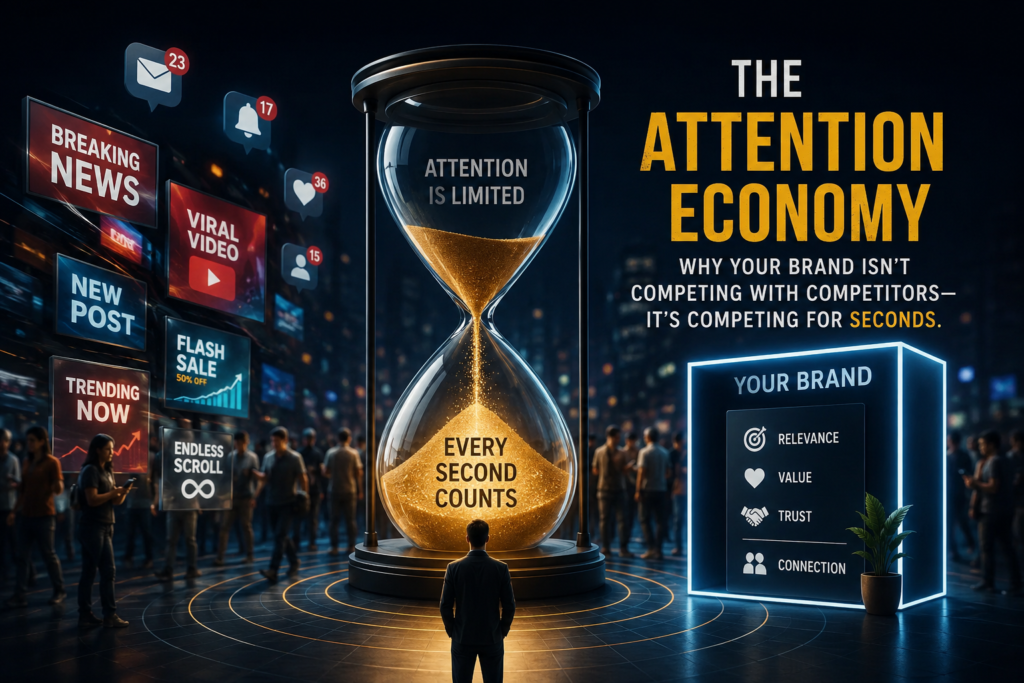
In today’s hyperconnected digital world, brands face a challenge unlike any they have encountered before. Consumers are no longer limited by access to information; instead, they are overwhelmed by an endless stream of content, advertisements, notifications, emails, and videos competing for their attention every second. Consequently, businesses are discovering that their greatest challenge is not outperforming their competitors but earning a few precious seconds of consumer attention. Human attention has become one of the most valuable and scarce resources in the world, a phenomenon known as the “Attention Economy.”
Moreover, every social media scroll, website visit, email notification, and online advertisement contributes to an increasingly competitive digital landscape. While businesses often focus on outperforming rivals, they frequently overlook the real competition: countless distractions that constantly pull consumers away. Therefore, understanding how attention works has become essential for every modern marketing strategy. Brands that recognize this shift can create meaningful experiences that strengthen customer engagement, improve brand awareness, and accelerate business growth.
Understanding the Attention Economy
What Is the Attention Economy?
The Attention Economy refers to an economic environment where human attention is treated as a scarce resource. Unlike products or services that can be manufactured repeatedly, attention cannot be increased. Every individual has only twenty-four hours in a day, making attention extremely limited and highly valuable. Consequently, every brand, creator, and platform competes to capture a share of that finite resource.
Why Attention Has Become a Valuable Asset
Furthermore, technological advancements have dramatically increased the volume of available information. Every day, consumers are exposed to hundreds of marketing messages on various channels. As a result, brands no longer compete only with businesses within their industry. Instead, they compete against entertainment platforms, social media feeds, streaming services, news outlets, influencers, mobile applications, and even personal conversations. Therefore, mastering the Attention Economy requires businesses to understand consumer psychology rather than simply producing more content.
Your Biggest Competitor Is Distraction
Competing Beyond Your Industry
Many businesses mistakenly believe that their primary competitors are companies selling similar products or services. However, the modern consumer rarely compares brands side by side. Instead, they constantly decide whether any content deserves their immediate attention. Consequently, every notification, viral video, trending meme, or breaking news story becomes your indirect competitor.
Why Every Second Matters
Additionally, research consistently shows that consumers switch between digital platforms within seconds. If your content fails to create immediate interest, users simply continue scrolling. Therefore, businesses must recognize that every second matters. Instead of asking, “How can we beat our competitors?” “How can we become impossible to ignore?” is a question that marketers ought to pose. This subtle shift in thinking fundamentally transforms digital marketing strategies.
The Science Behind Human Attention
How the Brain Filters Information
The human brain constantly processes enormous amounts of information. However, it selectively filters incoming content to prevent cognitive overload. Consequently, people naturally pay attention to information that appears valuable, entertaining, emotionally engaging, or personally relevant.
Psychological Triggers That Capture Attention
- Curiosity
- Surprise
- Emotional storytelling
- Personal relevance
- Visual appeal
The Emotional Connection
Moreover, emotions significantly influence attention. Stories that inspire curiosity, excitement, surprise, or empathy receive greater engagement than purely informational content. Therefore, brands should move beyond simply promoting products and instead create stories that establish lasting emotional connections.
Why the First Five Seconds Matter More Than Ever
The Power of First Impressions
Whether someone watches a video, visits a website, opens an email, or views a social media post, they decide within seconds whether to continue engaging. Consequently, those first few moments determine whether a brand gains attention or loses it forever.
Elements of an Effective Opening
Headlines
Create curiosity while clearly communicating value.
Visual Design
Use high-quality visuals that immediately attract attention.
Call-to-Action
Encourage users to continue reading, watching, or interacting.
Content Is No Longer King—Relevant Content Is
Quality Over Quantity
For years, marketers repeated the phrase “Content is King.” While content remains essential, quantity alone no longer guarantees success. Instead, relevance has become the defining factor. Consumers expect personalized, useful, and engaging experiences tailored to their interests.
Creating Meaningful Content
Additionally, algorithms increasingly reward content that generates meaningful interactions rather than simple impressions. Consequently, businesses should prioritize educational blogs, compelling videos, insightful infographics, and authentic storytelling.
Types of High-Performing Content
Educational Blogs
Provide practical solutions to audience problems.
Video Content
Increase engagement through storytelling and demonstrations.
Infographics
Present complex information in a visually appealing format.
Bonus Tip
Repurpose one piece of content into multiple formats to maximize audience reach.
The Role of Video in Capturing Attention
Why Video Dominates Digital Marketing
Video combines visuals, sound, motion, and storytelling, making it one of the most engaging content formats. Consequently, businesses investing in video marketing often experience higher engagement and stronger brand recall.
Best Practices for Video Marketing
Rather than focusing solely on shorter videos, brands should ensure every second delivers value. Whether producing tutorials, behind-the-scenes footage, customer testimonials, or educational content, quality storytelling should remain the priority.
Building Brand Trust in a Distracted World
Authenticity Creates Loyalty
Capturing attention is only the beginning. Retaining that attention requires trust. Consumers increasingly recognize exaggerated marketing claims and quickly disengage from brands that appear inauthentic.
Consistency Builds Long-Term Relationships
Moreover, transparent communication, consistent messaging, and valuable educational content help establish credibility. Consequently, trust becomes a powerful driver of customer loyalty and long-term business growth.
Measuring Attention Beyond Likes and Views
Vanity Metrics vs. Meaningful Metrics
Although likes, impressions, and follower counts provide useful insights, they rarely reveal genuine audience attention. Consequently, marketers should evaluate more meaningful engagement indicators.
Key Metrics to Track
- Watch Time
- Reading Duration
- Click-Through Rate (CTR)
- Shares
- Comments
- Returning Visitors
- Conversion Rate
Using Data to Improve Strategy
Furthermore, businesses should continuously analyze these metrics to optimize future campaigns. By focusing on meaningful engagement instead of vanity metrics, organizations create stronger marketing strategies that generate measurable results.
Winning the Battle for Seconds
Create Value Immediately
The brands that succeed tomorrow will not necessarily have the largest advertising budgets. Instead, they will understand how to consistently earn and maintain consumer attention. Every headline, image, video, website, and social media post should immediately communicate value while encouraging deeper interaction.
Invest in Relationships, Not Just Reach
Additionally, successful brands recognize that attention is earned rather than demanded. They invest in creativity, authenticity, storytelling, and exceptional customer experiences instead of relying solely on promotional messaging.
Every Second Is an Opportunity
The Future Belongs to Attention-Driven Brands
The Attention Economy has fundamentally transformed how businesses compete in the digital marketplace. Brands are no longer competing exclusively against industry rivals. Instead, they compete against every distraction capable of capturing consumer attention. Therefore, success depends less on having the biggest budget and more on delivering immediate value, meaningful experiences, and memorable stories.
Final Thoughts
Ultimately, businesses that understand attention as a valuable resource can build stronger relationships with their audiences while achieving sustainable growth. By focusing on relevance, authenticity, emotional storytelling, and customer-centered experiences, organizations position themselves to thrive in an increasingly crowded digital environment. In a world overflowing with information, attention has become the ultimate competitive advantage.